Gulf of Maine Marine Biodiversity Observation Network
The Gulf of Maine MBON, a regional node of the Marine Biodiversity Observation Network (MBON) monitors the quantity of the copepod Calanus finmarchicus to understand the health of the marine ecosystem and effectively manage its services.
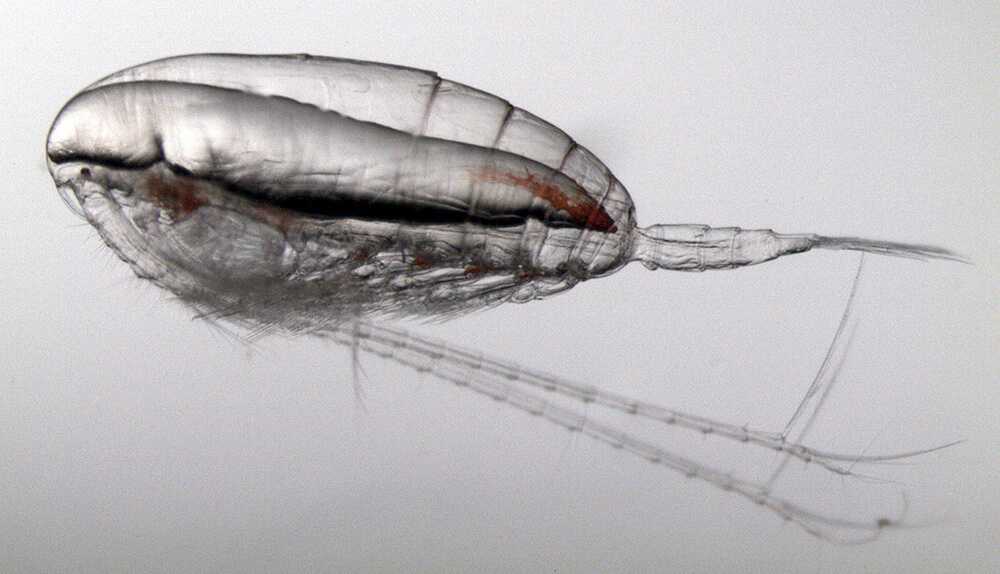
The Gulf of Maine (GoM) ecosystem is undergoing a period of rapid change. Of particular concern is the declining population of the energy-rich copepod Calanus finmarchicus, a plankton that forms the base of the marine food web, and whose abundance affects fish, marine mammal, and seabird populations. Gathering and analyzing data on plankton biodiversity is expanding our understanding of how the forage base is structured, how it is changing, and what the implications of those changes are to other species and the broader ecosystem.
Observations & Modeling Used
- Microscopy is used to identify zooplankton and phytoplankton species captured via bongo nets.
- Flowcam is used to automate identification of small nano and pico-plankton.
- eDNA metabarcoding is used to identify lower trophic levels.
- Seascapes are used to predict water masses based on satellite imagery.
- Lipidscape modeling is used to understand how energy travels through the Gulf of Maine foodweb.
- CTD casts are captured monthly to understand the oceanography at each time series station.
Ongoing Results & Analysis
- Calanus Index
- The response of the mesozooplankton community in the western Gulf of Maine to changing oceanographic conditions: The 2010 regime shift.
- Zooplankton monitoring at fixed station time series detects responses of the foundation species, Calanus finmarchicus, to seasonal and multiannual drivers in the western Gulf of Maine. ICES Journal of Marine Science, Proceedings of the Zooplankton Production Symposium
- Modeling the advective supply of Calanus finmarchicus to Stellwagen Bank as an indicator of sand lance foraging habitat, and the climate vulnerability of a National Marine Sanctuary
- Seasonal trophic controls drive population variability in a foundational marine copepod
- Drivers of Phytoplankton Communities Across Thermal Regimes and Marine Heatwaves in the U.S. Northeast Shelf
Project Partners


Funding Provided by